Workplace Mental Health Training in Glasgow, Scotland and the UK
Mental health training that actually makes a difference
Nationally accredited or fully bespoke, delivered by practising therapists who do this work every week, not trainers reading someone else's slides.
Training a team near you? We deliver at your workplace across Scotland and England.
No two organisations are the same. So neither is the training.
From small local charities to multinationals and fellow training providers, whatever your size, sector or starting point, there's a route that fits.
Training that works for your budget and your people.
Flexible group pricing, practical sessions and a thoughtful approach to teams already doing emotionally demanding work.
Go beyond mandatory training.
Build confident managers, create consistency across teams and understand the difference your training is making.
Add workplace mental health training to your offer.
Partner with us to expand what you can offer your clients, while keeping the client relationship firmly yours.
Doing nothing is the expensive option.
Poor mental health is already on your P&L: in absence, cover, turnover and the quiet cost of people working at half capacity.
What's your organisation's risk score?
Seven quick questions. You get an instant, tailored estimate of your organisation's mental health risk, and what it could be costing you.
Question 1 of 7
How many people work at your organisation?
Question 2 of 7
What sector are you in?
Question 3 of 7
Roughly how many working days were lost to mental health related absence last year?
Question 4 of 7
Have any of your people had mental health first aid or awareness training?
Question 5 of 7
In the last year, has anyone left your organisation for reasons connected to stress, burnout or mental health?
Question 6 of 7
If a team member seemed visibly distressed at work tomorrow, how confident are the people around them would know what to say?
Question 7 of 7
What's your current mental health support for staff?
Almost there
Where should we send your result?
Your result
High risk
Scored 0 out of 9
Estimated annual exposure
£0 to £0
Based on your headcount, your current absence pattern, and the level of mental health training your people have had
Estimates based on CIPD's Health and Wellbeing at Work 2025 report, FirstCare UK absence cost data, and the Oxford Economics / Unum Cost of Employee Turnover study. Figures are UK averages and provide an estimate, not a guarantee.
A Bitesize Workshop starts from £385, under 3% of your estimated exposure
Getting your people trained costs a small fraction of what untrained mental health risk is already costing you.
Employers typically get back £5, and up to £11 for early intervention, for every £1 spent on workplace mental health support (Deloitte, with Mind)
What most employers don't know
You have a legal duty of care for your people's mental health, not just their physical safety. Under the Health and Safety at Work etc Act 1974, employers must protect employee health, safety and welfare, and this duty covers mental as well as physical health.
Separately, under the Equality Act 2010, a mental health condition can meet the legal definition of disability if it has a substantial, long term effect on someone's ability to do their job, which brings a duty to make reasonable adjustments. If that duty isn't met and a case reaches tribunal, compensation for discrimination is uncapped.
Based on your answers, the best place to start is
Bitesize Workshops
Start where you are. Not where a brochure says you should be.
Bitesize workshops
Focused 90-minute sessions on one topic. Eleven to choose from, online or on-site.
- ✓Stress & burnout
- ✓Resilience & psychological safety
- ✓Supporting a colleague in distress
Workplace Mental Health Qualifications
A progressive qualification pathway designed for different levels of responsibility within the workplace.
- ✓SCQF Level 4: Mental Health Awareness in the Workplace
- ✓SCQF Level 5: Managing Mental Health Awareness in the Workplace
- ✓SCQF Level 6: Advanced Leadership in Workplace Mental Health
RQF Level 1 to 3 equivalents
Bespoke programmes
Designed around your people, your sector and your strategic goals, including systems reviews.
- ✓Manager & leadership programmes
- ✓Sector-specific training
- ✓Strategic consultancy & systems review
Big impact.
Just 90 minutes.
Eleven focused workshops on the topics your team actually needs, from burnout to psychological safety. Online or on-site, built to fit around a working day.
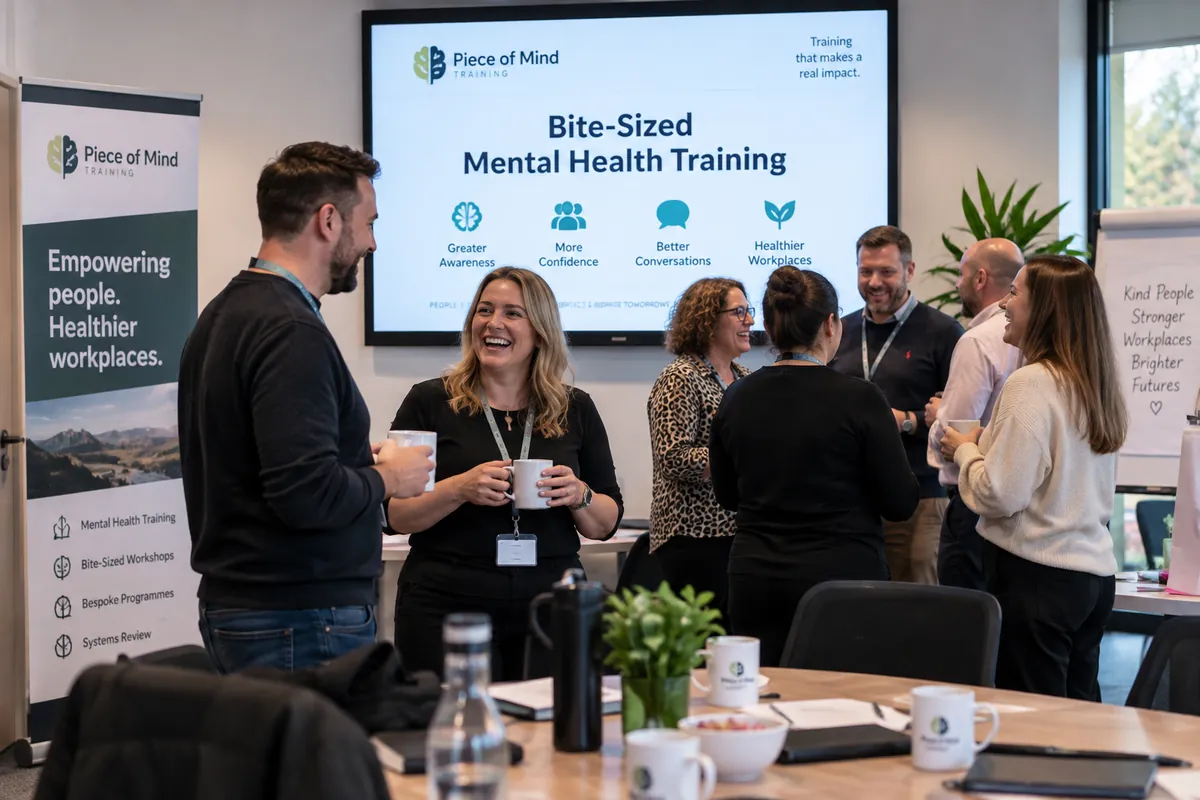
We don't just deliver training. We make sure it makes a difference.
Every session is built to connect with your people, get them involved and leave them confident enough to actually use what they've learned.
Expert-led
Practising therapists and frontline practitioners, including a serving paramedic, not slide readers.
Recognised qualifications
Workplace mental health qualifications credit rated within the SCQF, with a clear pathway from awareness through to advanced leadership.
Practical tools
Frameworks people actually use the morning after the workshop, not theory they forget by Friday.
Support that stays
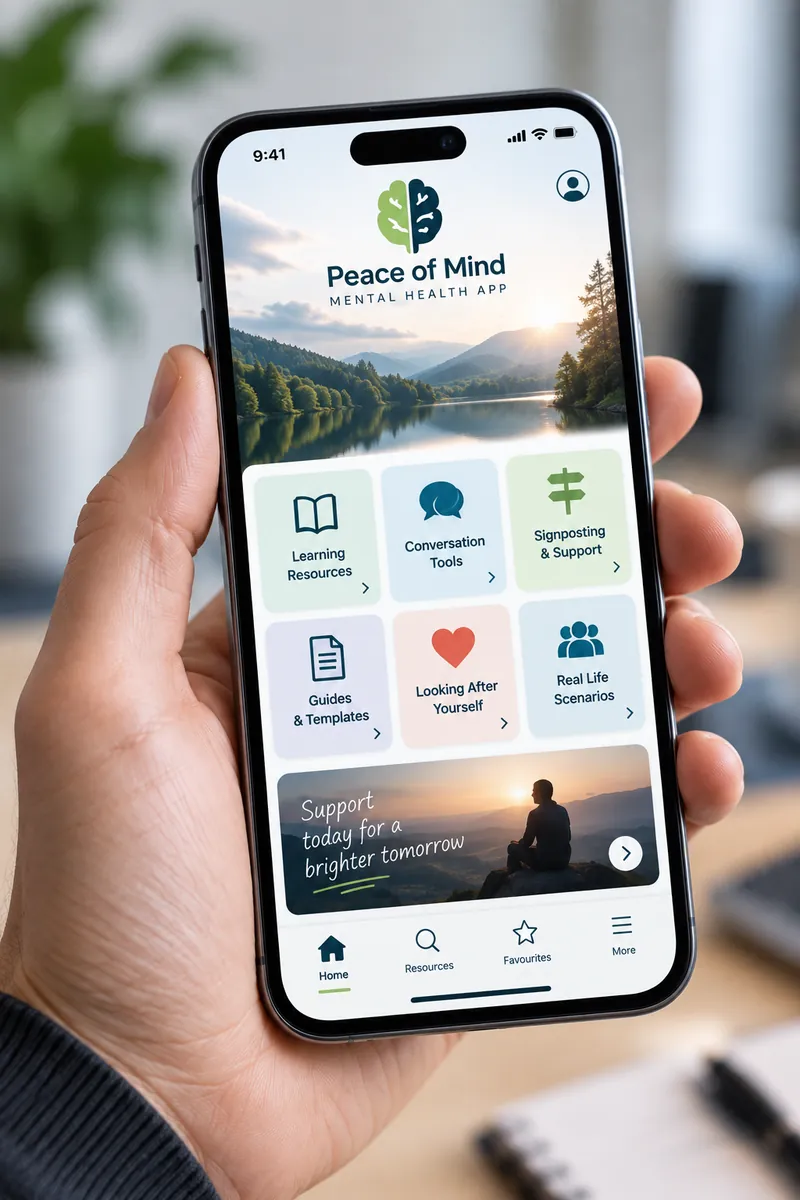
Every learner leaves with the Reach Out app, resources and trainers they can come back to.
The training ends.
The support doesn't.
Training isn't a transaction. Once we've worked with your team we stay in their corner, embedding what they learned into daily working life.
What people say afterwards
Trusted by organisations across the UK and Europe
What has stood out most is the way Andy operates as a genuine extension of our team rather than simply as an external supplier. He brings strong subject-matter expertise, is highly responsive, and has consistently helped us identify and deliver the most appropriate provision.
The results to date have been excellent, and we would be very happy to recommend Andy and Piece of Mind to other organisations looking for a trusted, consultative partner in this space.
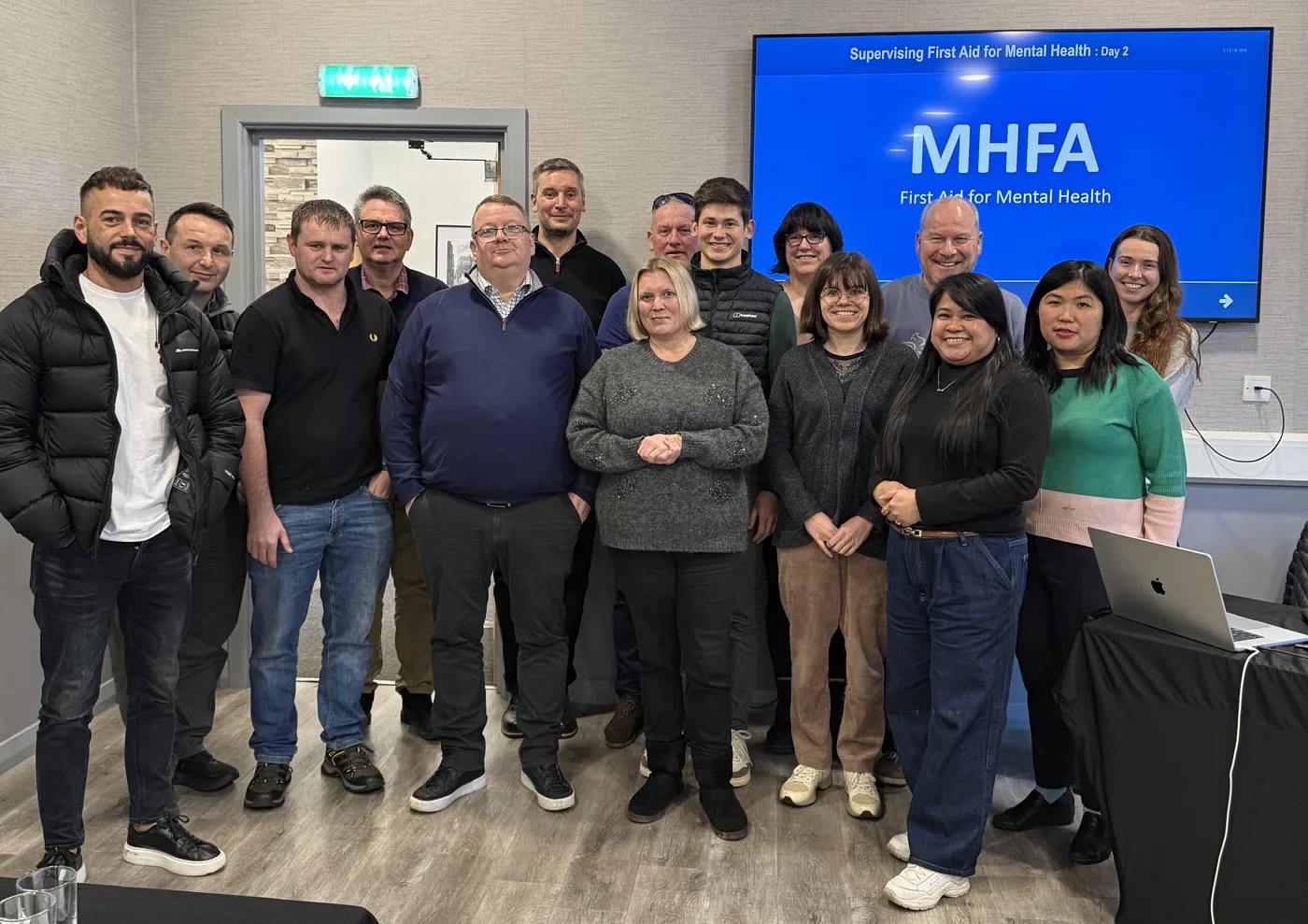
Mental health first aid across the UK and Europe
A multinational in a safety critical industry. Training in Edinburgh and Norway gave people the confidence to notice a colleague and say, "Are you okay?"
Read the full story450 managers in a high pressure regulatory organisation
A 12 month bespoke programme in the public sector, in person and online, built around the organisation's own policies and legal duties. About half way through.
Read the full storyFAQ
Frequently asked questions
The questions we're asked most before an organisation books training with us. If yours isn't here, get in touch and we'll answer it directly.
About the Training
What actually is First Aid for Mental Health training?
For us, effective mental health training isn't about becoming obsessed with knowing every mental health condition or trying to turn people into therapists. It's about understanding people. People operate in patterns and behaviours. Sometimes it's obvious that somebody is struggling and sometimes they're very good at hiding it behind a performance mask. The training gives you the confidence to recognise when something might not be right, know how to approach somebody without closing them down, understand what to say and what not to say, and help connect that person with the right support. It's about knowing what you can do within your role, understanding where your responsibility ends and helping somebody get the support they need.
What will I actually be able to do differently after the course?
Hopefully, you'll feel much more confident. If somebody is struggling, or a colleague comes to you because they're worried about somebody else, you'll have a much clearer idea of what to do next. Rather than panicking about saying the wrong thing, you'll be able to think about the situation in a more joined-up way, start the conversation and help that person towards the support they need. That's really what we want people to leave with: confidence.
Will I be expected to diagnose mental health conditions?
Absolutely not. We're not training you to diagnose anybody. We give you enough understanding of different mental health conditions to recognise signs that somebody might be struggling and to understand some of the ways those difficulties can show up. The important part is what you do with that information. You don't need to know exactly what's "wrong" with somebody to notice that something has changed, start a conversation and offer support.
What mental health difficulties do you cover?
That depends on the level of training you attend. We cover commonly encountered issues such as stress, anxiety, depression and burnout, as well as areas including OCD, bipolar disorder, personality disorders, self-harm and suicide awareness at the appropriate levels. We look at signs and symptoms and how different difficulties might show up in everyday life and in the workplace. But it isn't a conditions-based course. We don't want people leaving with a head full of diagnostic criteria. We want them leaving knowing what they might notice and, most importantly, what they can do about it.
Does the training cover stress and burnout?
Yes. Mental health isn't only about somebody having a diagnosed condition. We look at some of the things that can contribute to people becoming overwhelmed or unwell, including stress and burnout. We also explore how the workplace itself can sometimes unintentionally contribute. That means we're not only looking at what happens once somebody is struggling. We're also thinking about what organisations can do earlier.
Is the training useful outside work?
Absolutely. Although we're often delivering the training within workplaces, what you learn doesn't suddenly stop being useful when you leave work. You may find yourself using it with a friend, somebody in your family, within your community or in your wider social circle. We see it as a genuine life skill.
Choosing the Right Training
What's the difference between the half-day, one-day and two-day courses?
The half-day course is a fantastic starting point and provides a strong level of awareness. The one-day and two-day programmes progressively go into greater depth and give learners more knowledge, practical understanding and confidence. But we don't believe course level should simply be determined by somebody's job title. Someone on the factory floor may need a different level of knowledge from somebody doing a similar job in another organisation because their environments, responsibilities and existing support systems are different. That's why we'd rather have a conversation first and help you work out what actually fits.
Should we only train managers and HR?
No. Ideally, mental health awareness exists throughout an organisation. The person who notices somebody struggling might be their manager, but equally it could be the receptionist, somebody working beside them on the shop floor, another driver, a cleaner or a colleague they happen to trust. Different people may need different levels of training, but having eyes and ears throughout an organisation means there is a better chance of changes being noticed earlier.
Do managers need different training?
Managers can face additional challenges because they're often dealing with absence, performance, return-to-work conversations and difficult situations where wellbeing and organisational responsibilities overlap. That's why we also provide manager-focused training. We look at how to have those conversations, how to support somebody appropriately and how relevant organisational procedures and legal considerations fit around the person. The aim is to give managers a more complete, three-dimensional view of the situation rather than looking at wellbeing, performance and procedure as completely separate things.
How many Mental Health First Aiders should an organisation have?
There isn't one statutory number of Mental Health First Aiders that applies to every organisation. The right provision depends on things such as the size of the organisation, how and where people work, shift patterns, risk, remote working, existing support and the environment people are working in. That's why we'd rather understand the organisation before simply giving you a number. It's also worth distinguishing this from physical workplace first aid. Employers are required to make adequate and appropriate physical first-aid provision based on a first-aid needs assessment; there isn't one universal legal ratio that applies to every workplace.
What if we already have an EAP, Occupational Health or another wellbeing service?
Those services can be incredibly valuable, but having support available and somebody knowing how to connect a struggling person with that support are two different things. Mental Health First Aiders and trained managers can become an important connection point. The strongest organisations tend to have the different pieces working together: trained people, clear policies and procedures, appropriate professional support and straightforward routes for somebody to access it. It's about joining the dots.
What if we're not sure what training we actually need?
That's completely fine. In fact, we'd much rather you tell us that than buy a course simply because it sounds like the right one. We'll spend some time understanding your organisation, what you already have in place, what challenges you're experiencing and what you want to achieve. Sometimes the answer will be one of our existing courses. Sometimes it might be bespoke training. Sometimes there are things within the organisation that would benefit from being addressed alongside the training. The training should fit your organisation. Your organisation shouldn't have to fit the training.
How We Deliver the Training
Is this an off-the-shelf course?
We developed our training from the ground up because we wanted to create something that genuinely changes how confident people feel when they're faced with a real situation. That gives us a degree of flexibility that is really important to us. Where appropriate, we can adapt examples, conversations and emphasis around the people in the room and the environment they actually work in. We're not interested in simply getting through a slide deck.
Can you tailor the training to our organisation?
Absolutely. We work across different sectors and organisations, and the challenges aren't always the same. Sometimes one of our existing accredited programmes fits perfectly. Sometimes we adapt the delivery around the organisation, and sometimes a completely bespoke piece of training makes more sense. We start by understanding what you need rather than assuming we already know.
Can our own policies and support services be incorporated?
Yes, and where possible we actively encourage it. An organisation may already have excellent policies, an EAP, Occupational Health, HR processes and other support. The important thing is whether the person sitting in the training knows how all of those things connect when somebody actually needs help. Where appropriate, we can discuss your own support routes and procedures so learners understand what happens in their organisation, rather than only learning a generic process.
Is the training mostly PowerPoint and theory?
Absolutely not. The training is designed to be engaging, informal and practical. We use discussion, scenarios and real-world situations so people can think about what they would actually do rather than simply memorising information. We want people to feel part of the training, because that's where confidence starts to develop.
Do I have to role-play or speak in front of everyone?
Only if you want to. There may be scenarios that you work through with colleagues, because practising conversations can be incredibly useful, but we're not interested in deliberately making people uncomfortable. You won't suddenly be dragged to the front of the room and made to perform in front of everybody.
What if I'm quiet or nervous in groups?
That's absolutely fine. You don't need to be the loudest person in the room or join in with every discussion to get something from the training. We deliberately keep our training calm, informal and grounded. We want people to feel comfortable enough to learn rather than worrying about being put on the spot.
Can the training be delivered online?
Yes. Our training can be delivered both face-to-face and online, and we work hard to retain the interaction and practical elements in both formats. Online doesn't have to mean sitting silently watching somebody present slides for hours.
How many people can attend?
For our accredited courses, we train up to 16 people per course. For bespoke training and bite-sized workshops, we can work with groups of up to 20 people. Keeping groups at sensible sizes allows people to interact, ask questions and actually be part of the learning.
Can you deliver across multiple sites?
Absolutely. We deliver training throughout the UK and can work with organisations operating across multiple sites and locations. We've also delivered training internationally.
Can you manage a large organisational rollout?
Yes. We can deliver anything from a single course through to a programme involving multiple cohorts over a number of months. We're currently involved in a programme training more than 500 managers over a 12-month period, so we're very comfortable planning training at scale while still keeping individual course groups manageable.
Assessment, Qualifications and Learner Support
Do I need previous mental health knowledge?
Not at all. Most people attending our training don't come with specialist mental health knowledge. You might already have experience through work, physical first aid, previous training or your own life, and that's absolutely fine too. The training is designed to meet people where they are.
Is there an assessment?
Our accredited programmes include an assessment so that we can demonstrate that learning has taken place. Depending on the level, that may include things such as questions, multiple-choice assessment or practical elements. It isn't designed to catch you out. We're interested in whether you've understood what you've learned, not whether you're brilliant at sitting exams.
What if I struggle with assessments or have additional support needs?
Please tell us. We want to know about additional needs before the training wherever possible so that appropriate reasonable adjustments can be considered within the requirements of the course and assessment. If somebody is struggling with a particular assessment format, the facilitator can work with them and, where the assessment rules allow, look at an appropriate way for them to demonstrate their understanding.
What happens if I don't pass first time?
We're not interested in simply marking somebody as a failure and moving on. The facilitator will work with the learner to understand where they're struggling and what further support is appropriate. Where the assessment requirements allow it, that may include using a different appropriate way of helping the learner demonstrate their knowledge. The purpose is to establish that learning has taken place.
What if the subject matter becomes difficult for me personally?
Mental health training can touch on things that people have experienced themselves or through somebody close to them. We take that seriously. At the beginning of the training we make it clear that if something becomes difficult, you can step out, take some space or speak privately with the trainer. Our trainers are comfortable having those conversations and psychological safety is important to how we deliver the course.
Who actually delivers the training?
Our training team brings together professional teaching and training experience with real-world experience of supporting people. Our team includes people from backgrounds such as teaching, frontline healthcare and policing, alongside therapeutic experience and lived experience of mental health difficulties. The important thing for us is that the person delivering your course understands more than the slides. They understand what these conversations can look and feel like in real life.
Handling Real Situations
Does the training cover suicide and self-harm?
Yes, at the appropriate levels. These are exactly the kinds of moments where somebody needs more than vague awareness. They need to know how to respond, what questions they can ask, what their boundaries are and when additional or urgent support is needed. We also challenge common myths, including the fear that simply asking somebody directly about suicide will somehow put the idea into their head. The aim isn't to turn learners into crisis professionals. It's to help them respond appropriately rather than hoping they'll somehow know what to do when the moment arrives.
What if I ask somebody if they're okay and they don't want to talk?
That's one of the real-world situations we train people for. Not every conversation ends with somebody immediately opening up and telling you what's wrong. We look at how you can respond without pushing, how you can leave the door open and how you might follow up appropriately. Knowing what to do when somebody says, "I'm fine," is just as important as knowing what to do when they tell you everything.
What about confidentiality?
Confidentiality, boundaries and escalation are important parts of the training. What happens with information somebody shares can depend on the circumstances, the level of risk, safeguarding considerations, the person's wishes and the organisation's own policies and procedures. We help learners understand those boundaries, including situations where something may need to be recorded, shared or escalated. The aim is to avoid people making promises such as "I won't tell anybody" before they understand what they've actually been told.
What if someone's mental health is affecting their attendance or performance?
This is particularly relevant within our manager training. A manager may need to think about the person's wellbeing, performance or attendance, organisational procedures and relevant employment and equality considerations at the same time. For example, some mental health conditions may meet the Equality Act 2010 definition of disability where a mental impairment has a substantial and long-term adverse effect on normal day-to-day activities. That is determined by the individual circumstances; having a mental health diagnosis does not automatically mean every person meets that definition. We help managers understand how to have supportive conversations without forgetting that they also have a management role. Good culture makes those conversations easier. If openness, regular conversations and clear routes to support already exist, the first conversation about somebody's wellbeing is less likely to happen only when things have reached crisis point.
What Happens Afterwards?
What support is available after the training?
For us, the certificate isn't the end of the process. Learners can have access to practical resources through our app, giving them something they can return to when a real situation happens months after the course. That can include conversation prompts, practical guides, examples and other resources designed to refresh what they learned when they actually need it. For organisations, we can also provide further bite-sized learning, refresher training, support for Mental Health First Aiders and ongoing development. We see delivering the training as the beginning of a relationship, not the end.
How do we know whether investing in workplace mental health is actually making a difference?
We encourage organisations to look at their own data rather than simply counting certificates. That could include mental-health-related absence, overall absence, retention and turnover, use of existing support services, learner confidence and whether people are accessing support earlier. Some of the costs associated with poor mental health can be surprisingly difficult to see on a balance sheet because they're spread across absence, reduced productivity, recruitment, turnover and management time. There is also wider evidence for investment in workplace mental health. Deloitte's 2024 UK analysis estimated that employers receive, on average, around £4.70 in improved productivity for every £1 invested in employee mental health and wellbeing interventions. That's an average across evidence reviewed by Deloitte, not a guaranteed return for every individual programme. The most useful question for us, though, is what is changing inside your organisation.
For Organisations
Can you review what we already have before recommending training?
Yes. Sometimes training isn't the only gap. We offer a service where we can look at existing mental health provision alongside relevant policies, procedures and support pathways and identify where things aren't joining up. There's little value in training Mental Health First Aiders and then putting them back into an organisation where they don't know where to take somebody next or where the systems don't support them. Sometimes the smartest thing to do is improve the system alongside the training.
How do you stop Mental Health First Aiders becoming the dumping ground for everybody's problems?
By teaching boundaries and making sure the organisation supports the people it has trained. A Mental Health First Aider isn't a therapist and shouldn't become responsible for fixing everybody. They need clear boundaries, escalation routes and somebody they can speak to themselves. They also need enough capacity within their role to have these conversations rather than being expected to somehow fit them on top of an already impossible workload. The people providing support need support too.
What should we put in place to support our Mental Health First Aiders?
There isn't one answer for every organisation, but there should be a clear structure around them. They should understand where they can escalate concerns, who they can speak to if a conversation has affected them, what support services are available and what their boundaries are. They also need realistic time and capacity to fulfil the role. Simply training somebody and adding "Mental Health First Aider" to their list of responsibilities isn't enough.
How much does the training cost?
Training can start from around £95 per person, depending on the programme and delivery model. We offer both per-person pricing and whole-course fees for our accredited programmes. Our current prices are clearly displayed on our website so organisations can see the costs before speaking to us.
Are there hidden costs for materials, assessments or certificates?
No. Our quoted costs include the learning materials, assessment, certification and applicable qualification fees. We don't want organisations discovering additional compulsory charges after they've booked.
What should we compare when looking at different training providers?
Price matters, but we'd encourage organisations to look beyond the day rate or per-person figure. Ask what people will actually be able to do differently afterwards. Look at how practical the training is, whether it can reflect your organisation, who is delivering it, what support learners receive afterwards and whether the training connects with the systems you already have in place. For us, the goal isn't simply to get through the content. It's to build confidence so that when somebody is faced with a real person having a difficult day, they have some idea what to do.
Why should workplace mental health be more than a tick-box exercise?
Because your organisation depends on its people. Businesses routinely invest time and money maintaining the equipment, systems and infrastructure they rely on because they understand the cost when those things stop working. People deserve at least the same seriousness of attention, not because they're pieces of machinery, but because organisations simply don't function without them. When people genuinely feel that the organisation is interested in their wellbeing, it can contribute to a healthier culture where people are more comfortable speaking up, seeking help and supporting each other. Mental health training shouldn't be something you do simply so you can say you've done it. It should form part of how you look after the people who make the organisation work.
We know we need to do something, but we don't know where to start. What should we do?
Just have a conversation with us. We're not interested in giving you a hard sales pitch or automatically selling you the biggest programme we offer. We want to understand where you are now, what you've already got in place and what you're trying to achieve. If we think we can help, we'll explain how. If we genuinely don't think we're the right people for something, we'll tell you that too. Getting it right matters to you, and it matters to us. It starts with a conversation.
Ready to invest in training that actually makes a difference?
Let's design something that fits your organisation, and stays with your people long after the session ends. Free 20-minute call, no pitch deck.