The short answer: mental health first aid training reliably improves what people know, how confident they feel and how willing they are to help. The evidence that it improves the mental health of the people they go on to support is much weaker, mostly because very few studies have measured it properly. Training is a good start. What happens around it decides whether it makes a real difference.
I run a mental health training company, so I am not neutral here. I still think employers deserve a straight answer to this question, and I would rather you heard it from a provider than found it in a comment thread after you had already booked.
What has the research found?
Most of the research is on one widely used programme, Mental Health First Aid, which began in Australia in 2000 and is now delivered under licence in many countries. Other courses, including ours, cover similar ground, so the findings are a fair guide for all of us.
| Review | What it looked at | What it found |
|---|---|---|
| Morgan, Ross and Reavley, 2018 | 18 trials, around 5,900 people | Better knowledge, better recognition of mental health problems, more confidence and stronger intentions to help. Effects were small to moderate and lasted up to six months. A small increase in how much help people gave, but the quality of that help was unclear. |
| Forthal and colleagues, 2022 | 9 studies that tested real world use | Mixed results on whether trainees actually used the skills. No effect found on the mental health of the people they helped. |
| Cochrane review, 2023 | 21 studies, over 22,500 people | Only five studies measured mental health in the organisations that adopted the training. The result may be a small improvement or no difference, and the reviewers had very low confidence in the evidence. |
| Health and Safety Executive, 2018, updated 2023 | Workplace studies | Training raises awareness. Limited evidence of lasting change, and nobody has yet measured whether it improves how organisations manage mental health. |
What does that mean for employers?
Three things are true at the same time.
The gains in knowledge and confidence are real, and they matter. People who cannot recognise when a colleague is struggling, or who are frightened of saying the wrong thing, usually say nothing. Training changes that.
A lack of evidence is not the same as evidence that it does not work. Measuring whether one conversation in a corridor changed someone’s mental health is genuinely hard. Many studies are small, short or not designed to answer that question.
A certificate is not an outcome. Be cautious of any provider, including us, who tells you their course is proven to improve mental health or will cut sickness absence by a set amount. The research does not support claims that strong.
Why does training on its own so often fade?
- Skills fade without practice. If someone learns a framework in March and has their first real conversation in November, much of it will have gone.
- There is no clear route after the conversation. A first aider who does not know how your EAP works, or who to tell when they are worried, gets stuck at the most important moment.
- The people trained are left carrying too much. Supporting a colleague through something serious is heavy. Without someone to talk it through with afterwards, good people step back.
- Training gets used instead of fixing the causes. If workload, culture or poor management are making people unwell, a trained first aider cannot fix that. The Health and Safety at Work Act already expects employers to assess and manage work related stress. We explain that in our guide for managers in Scotland.
What makes mental health training more likely to work?
Look for these, whoever you train with:
- Practice, not just slides. People remember rehearsing a difficult conversation far longer than they remember a diagram.
- Your own support routes built in. Your EAP, your escalation steps and who to call, so learners know exactly what happens next in your organisation.
- Managers trained, not just volunteers. Managers shape workload and culture. A first aider can only do so much if their manager does not understand.
- Support for the people you train. A chance to debrief, and a trainer they can come back to.
- Refreshers. Short, regular top ups keep skills alive beyond the six months the research suggests.
- Something real to measure. Before you start, agree what you will look at afterwards. That might be referrals to your EAP, staff survey questions on whether people feel able to speak up, absence patterns, or how confident your first aiders feel three and six months on.
We have written more about this in Why Most Mental Health First Aid Training Fails.

How do we approach it at Piece of Mind?
I am confident in our training, but I would rather show you how we work than ask you to take my word for it.
- Learning is checked, not just attended. Our courses are credit rated and recognised by Qualifications Scotland, with levels that are equivalent to the RQF in England, and each includes an assessment.
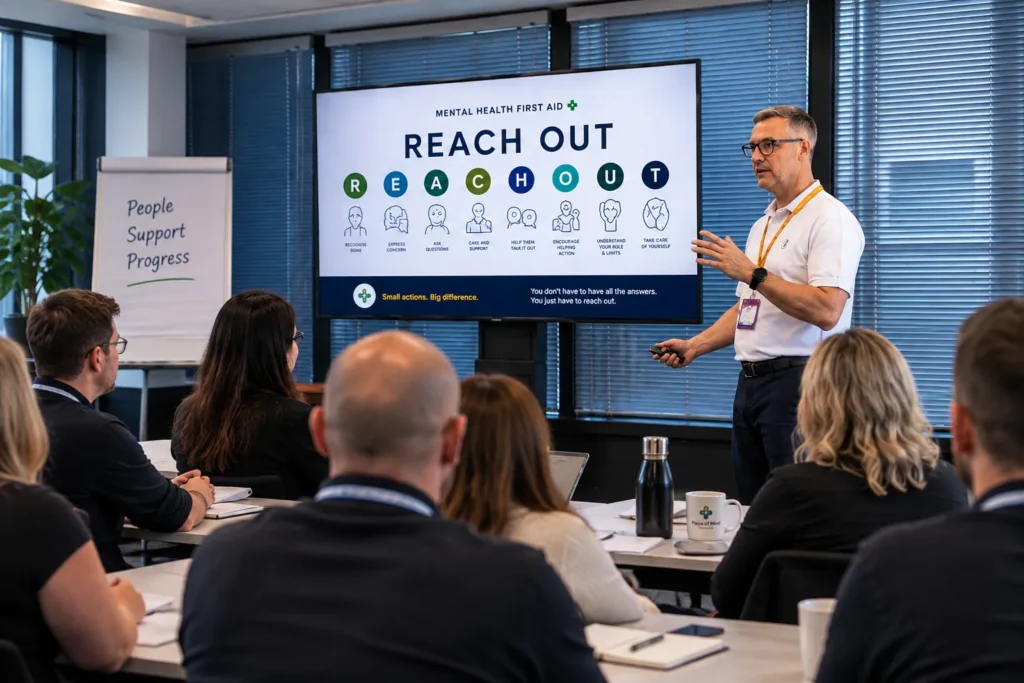
- A clear sequence for a real conversation. Our REACH OUT framework takes people from recognising risk through to connecting someone with support, and it includes understanding the limits of your role and taking care of yourself.
- Tied into your support structure. We link the training to the support you already have, so people know exactly where to turn next.
- The right people in the room. We work with you to choose who to train, rather than simply filling seats.
- Gaps found, not hidden. Along the way we look at where your support and policies have gaps, and talk honestly about what would close them.
- We help you measure the difference it makes. We will agree with you, before the course, what you will look at afterwards.
We do not guarantee results, and nobody honestly can. We are confident our methods hold up, and we will help you see that for yourself.
If you would like to see how we work before you spend anything, come along to one of our free mental health at work mornings for Glasgow employers. It is two relaxed hours at our training centre in Carmyle, with coffee, biscuits and no sales pitch.
Choosing a provider?
Our free one page checklist sets out ten questions to ask any mental health training provider, including us. Get the checklist
Frequently asked questions
Is mental health first aid training evidence based?
It is built on expert guidance, and research consistently shows it improves knowledge, confidence and willingness to help. The evidence that it improves the mental health of the people helped is limited and of low certainty.
Does mental health first aid training reduce sickness absence?
Research has not shown that yet, because very few studies have measured it. Treat any promise of a set reduction with caution, and agree how you will measure your own results.
Is mental health first aid training still worth doing?
Yes, when it is part of a wider approach that includes trained managers, clear support routes, follow up for the people you train, and action on the causes of work related stress.
How long do the effects of mental health first aid training last?
Studies suggest the gains last up to about six months. Less is known beyond that, which is why practice and refreshers matter.
The bottom line
Mental health first aid training is worth doing, and it is not magic. It gives people the knowledge and confidence to start a conversation they would otherwise avoid. Whether that turns into better mental health depends on what your organisation does around it.
Talk it through with us
If you would like to work out what would make a difference in your organisation, get in touch. And if we are not the right fit, we will tell you.
Sources
- Morgan, Ross and Reavley (2018). Systematic review and meta-analysis of Mental Health First Aid training. PLOS ONE.
- Forthal and colleagues (2022). Mental Health First Aid: a systematic review of trainee behavior and recipient mental health outcomes. Psychiatric Services.
- Cochrane (2023). Mental Health First Aid as a tool for improving mental health and well-being. Cochrane Database of Systematic Reviews.
- Health and Safety Executive. Summary of the evidence on the effectiveness of Mental Health First Aid training in the workplace (RR1135, 2018, updated 2023).