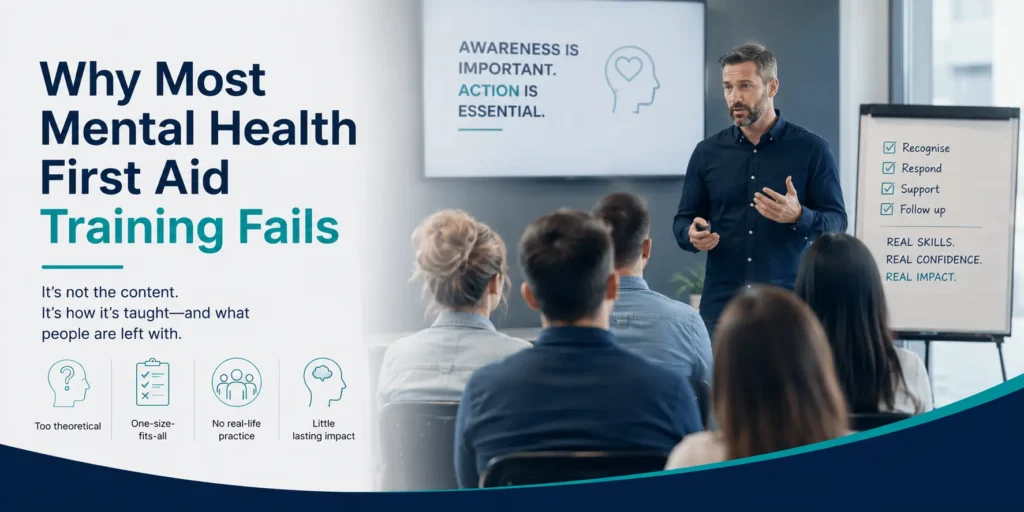
I’ll say this plainly. A lot of mental health first aid training does not work. Not because the training itself is bad on the day. People leave the room feeling motivated. They’ve had good conversations. They’ve filled in the workbook. Then six weeks pass, and most of it is gone.
This article is part of our practical guide to workplace mental health training for UK employers.
I don’t say that to have a go at other providers. I say it because I’ve watched it happen too many times, and because if we’re serious about this work, we have to be honest about why it keeps happening.
The training day was never the problem
Here’s the thing nobody likes to admit. The day itself usually goes well. A good trainer can hold a room, get people talking, get people to open up about their own experiences. By the end of it, people genuinely believe they’ll handle the next difficult conversation differently.
Then they go back to their desk. Back to their normal pace of work. Back to deadlines, meetings, the next fire to put out. Mental health first aid was never their job. It was a badge they picked up for a day, with the best of intentions, and very little support to keep it alive afterwards.
That’s not a willpower problem. It’s how memory works. Skills that aren’t used regularly fade, especially skills involving a difficult, emotionally loaded conversation that doesn’t come up every week.
The organisation around them often makes it worse
This is the part I think gets missed the most. We can train someone brilliantly, and they can still fail at the role, not because of anything they did, but because the organisation around them was never set up to support it.
Ask yourself honestly. Does your mental health first aider have any protected time to actually do the role? Is there a clear policy on what they’re meant to do if someone discloses something serious? Do they know who to escalate to, and when? Is anyone checking in on how they’re holding up, given they’re regularly absorbing other people’s difficult moments?
In most organisations I’ve worked with, the answer to most of those questions is no. We send someone on a course, give them a lanyard or a badge, and quietly hope the rest sorts itself out. It rarely does. The systems, policies and everyday culture around the role matter just as much as the training itself, and often more.
What actually happens three months later
Picture the realistic version of this. Three months after the training, someone in the team is clearly struggling. Your first aider remembers they did the course. They remember it was useful. They do not remember the exact opening line, the questions to ask, or the right place to signpost someone to.
That moment, right there, is where most mental health first aid training quietly fails. Not in the classroom. In the gap between the course finishing and the moment someone actually needs it.
Why we built the app around this exact gap
This is the bit I get genuinely animated about, because it’s the part most training providers leave out entirely. We don’t just deliver the day and walk away. Every learner gets ongoing access to our app, built specifically to sit in that gap between training and the moment it’s needed.
When something happens in the workplace, whenever that is, your first aider has it in their pocket. The app walks them through how to start the conversation, the actual opening lines that work. It covers signs and symptoms, so they can recognise what they’re looking at rather than relying on memory from a course months ago. And it covers signposting, so they know exactly where to direct someone rather than guessing.
It’s the difference between hoping someone remembers a workbook from months ago, and giving them a tool that’s still there, fully current, exactly when they need it.
Training is the start, not the whole job
If I had one thing to say to any HR director or operations lead reading this, it’s this. Ask your current or prospective training provider what happens after the course ends. Not in three months. Not in three years. What’s actually in place to keep that knowledge alive and usable, and what support exists for your first aiders, not just on day one, but for as long as they hold that role.
That question tells you more about the quality of a training programme than anything that happens in the room on the day itself.
The research says the same thing. We set out what the reviews actually found in Does mental health first aid training work? What the evidence says.
Where we go from here
We built our REACH OUT framework and our learner app because clinical depth on the day means very little if it disappears by the time it’s actually needed. If you’re responsible for wellbeing in your organisation and want training that’s still working three months, six months or three years from now, that’s exactly the conversation I’d like to have with you. Take a look at our Mental Health First Aid training, or get in touch and we can talk it through properly.
If your team is in or around Glasgow, we can train them at your workplace or at our training room in Carmyle. See our mental health first aid training in Glasgow.